
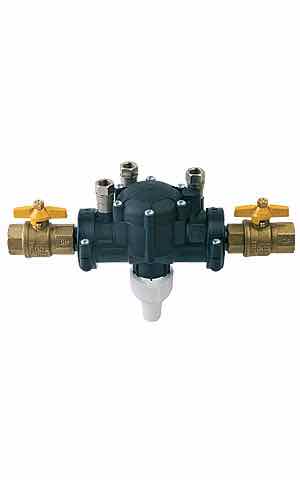
Backflow preventer valve for rainwater systems
The installation of backflow preventer valves is a legal requirement in many countries and is specified by Australian and American Rainwater Catchment Association Standards as minimum requirements for rainwater harvesting installations.
In anticipation of future regulations and in order to protect property owners from contaminating the municipal water supply, Use-Rainwater.com use backflow preventer valves in all their installations.
In most of the of the installations the the backflow preventer valves must be installed at the point where municipal water enters the property, generally just after the water meter. This ensures that the water within the property remains within the boundaries of the property and eliminates the risk of any backflow from the property to the municipal supply. The backflow preventor valves work extremely effectively and have very low and little maintenance requirements As part of their service to customers Use-rainwater annually test the backflow valves to ensure effective operation and continued protection of the property against backflow risks.
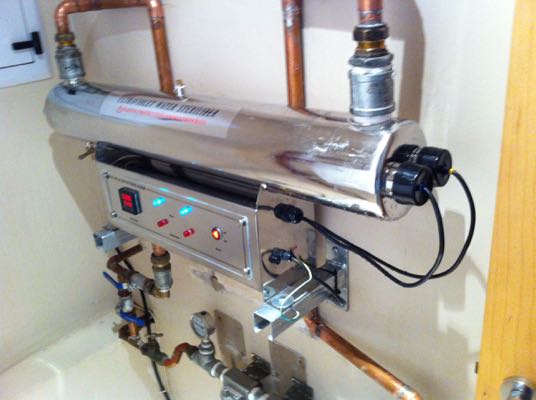
Ultraviolet water sterilizer
Our systems and design treat rainwater "on demand". We prefer not to use any chemical treatment, and therfore use Ultraviolet water sterilizers. as they can effectively kill the algae, fungi, bacteria, rickettsia and virus to purify the water.
These units work extremely effecetivly but it is important that they are sized correctly for the required water flowrate.
How do they work?
The ultraviolet ray is a kind of invisible light wave to the naked eye. It exists on the outside of the purple ray on the spectra thus it is called the ultraviolet ray. The ultraviolet ray is subdivided in wave band A (UVA), wave band B (UVB), wave band C (UVC). The wave length of UVC is between 100nm to 280nm - and the most effective germicidal wave band is 253.7nm.
- Principles: If you expose the water to UVC spectrum at the wave peak of 254nm for a period of time the nucleic acid, deoxyribonucleic acid (DNA) and ribonucleic acid (RNA) of microorganisms will absorb UV rays and be damaged by the rays – thus they perish - so the water is sterilized. UV rays have a certain effect on protein and other life forms too.
- An UV sterilizer is a completely physical way to sterilize water. It is easy to use, cost effective , broad spectrum, does not require any chemicals, generates no secondary pollution, does not create corrosion, leaves no residue and is easy to maintain.
- UV water sterilizer can be mounted as a pre or rear sterilization equipment with domestic or industry water purification equipment. It can be applied to various kinds of water purification.
- For it to work effectively the water must be free of particles larger than 5 micron.
