

Residential rainwater harvesting systems
Each residential property has its own specific requirement when it comes to the installation of a rainwater harvesting. There are essentially three types three types of systems that can be installed. They range from a very basic system that can be used to top up the pool of for gardening to very complex systems that harvest and treat rainwater for potable use. Many systems integrate with a backup water and water pressure booster systems to ensure that households have backup water when there is an interruption in municipal water supply and or when the water pressure in the main supply is very low.
The basic rainwater harvesting systems.
This system is very basic. It will contain a well installed tank, a primary rainwater filter and a valve at the bottom of the tank where water can be drained or a hosepipe can be connected to. It will harvest water off a 50 to 150sqm roof and will be exclusively be used for watering the garden and filling your pool. It does not contain any pressurized pump.
Intermediate non potable rainwater harvesting system
This system is more complex than the basic system and has a pressurized pump and control system together with a municipal backup water system. Rainwater recovery of a roof or hard surface area is maximized. The harvested rainwater is filtered with a WISY primary filter and stored in a tank. The water will primarily be used for non-potable applications. Dedicated water supply pipes will be installed for the flushing of toilets, general washing or gardening. When the rainwater tanks are empty the supply to the applications will revert to municipal water until the rainwater tanks are topped up again.
Deluxe potable rainwater harvesting water installations
Our Deluxe system is recognized as the world standard for treatment of rainwater for the use as drinking water. It has a 4-step rainwater treatment and water purification process.
Deluxe rain harvesting system Costs
This system is complex and purifies harvested rainwater for potable use. It combines with a municipal backup water system to ensure that the building has potable water at all times - even during municipal water interruption. This system is designed to be integrated into a new building and it is designed together with the architects and constructed during a construction of a new building
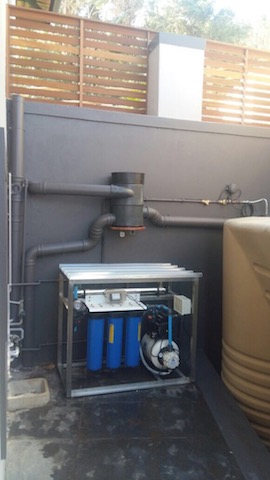
Intermediate rain harvesting system with backup water supply
This system is more complex than the basic system and has a pressurized pump and control system together with a municipal backup water system.This example will harvest water off a 250sqm roof. Water is non potable and can be used for washing, gardening and be connected to toilets and washing machines. It also contains a switch-over backup system if the municipal supply is interrupted or if the rainwater tanks are empty.
Key components:
- Two 5000l interconnected rainwater tanks. (10000l tank storage is the minimum in this application) An ideal would be 15000l tank storage capacity.
- Gutter and down-pipe modification in order to ensure that all the harvested rain water is directed to the interconnected rainwater tanks.
- Good solid hard surface/platform for tanks and pump
- Redirection and changes to gutter down pipes.
- Two inline primary WISY rainwater filters or one WFF 100 vortex filter (for this example we will use the WFF 100 vortex filter). All the water from the gutters will be directed to a single 110mm pipe that interconnect with the WFF100 vortex filter. The primary vortex filter is self-cleaning and screens out any organic material greater than 280 microns. It ensures that the rainwater tank is kept clean with minimal sludge buildup in the tank, thus improving the water quality and reducing the cleaning frequency of the tank (you would only have to clean the tank once every 5 years).
- One multi siphon overflow with vermin and insect protection. You want to protect the water quality in your tank. The multi siphon overflow prevent any insect or vermin from getting into the rainwater tanks - especially where the overflow is connected directly to the underground storm-water pipe.
- One calming inlet that will allow fresh rainwater from the vortex filter to enter the bottom of the tank and not disturb the sediment and microbiological layer on the bottom of the tank
- Tank level gauge so you can see the water level in the tank
- One floating suction connected to the suction of the pump. The floating suction draws water from just under the water surface ensuring that the old water in the tank is used first - keeping water fresh at all times in the tank.
- One externally pressure pump with a pressure controller mounted on on a pressure tank. We have found that this is the most cost and energy effective system as it does not start the pump when small amounts of water is used. It is fully automatic and as soon as a tap is opened fully, the pump will start to provide flow and pressure. You can also use a submersible pump, but for this example we will use an external pump.
- One fine screen filter on the pressure side of the pump to ensure that there are no particles in the water that can damage sensitive plumbing equipment.
- Once municipal top up solenoid valve and float switch system. By setting the a minimum water level in the tanks an electrical solenoid valve will always top an minimum amount of water to the tank. Thus if there is no rainwater or if the tanks are starting to empty, the system will automatically add some water to ensure you always have water for flushing toilets and washing. When it rains and the tanks fill up it will stop and the system will only use rainwater.
- One municipal switch-over system and bypass valve system. If anything goes wrong or if the system need to be maintained you can bypass it and simply use municipal water for a while.
- Backflow preventer valve and assembly. This is a critical element of the installation. When there is a risk that you can pump any water, but municipal water back into the municipal supply, you have to install a backflow preventer. It is not a non return valve, but a specialized valve built and designed for these applications. It also has to be inspected by a specialist plumber every year
Positive aspects.
- The building is harvesting and using rainwater more effectively
- If the municipal supply is interrupted the building will still have pressurized water to flush toilets.
- This system work well in small industrial applications like supplying make-up water to cooling towers.
- A good trained plumber with experience and the right components can do this type of installation.
Installation time is about 4-5 days.
For a few thousand rand extra you can easily convert this system to a fully potable rainwater harvesting system.
Negative aspects
- The water cannot be used for potable applications or in baths or showers, as it has not been treated and there might be a small risk of contamination. Therefore you are not fully utilizing the opportunity to use the harvested rainwater. There might be period during the summer rainfall season where the rainwater tanks will overflow because the rainwater in the tanks are just not used fast enough. Our estimate and simulation shows that you will lose approximately 25% of the potential harvested water in this way.
- The building requires a dual plumbing system to the bathrooms - rainwater to the toilets and municipal water to the tap and basin - which can be costly.
Estimated - Installed cost on site R75000 (Please note that these are estimates and can be used as guidelines only)
Potential amount of rainwater that can be recovered in a coastal zone with 1040 mm of rain per year is 185 000 liters per year.
