Benifits of using rainwater
Using rainwater as an alternative water source has many benefits for both domestic and commercial users. Benefits range from improved water quality to reducing water and utility bills
- Filtered and treated rainwater is of extremely good quality, it is extremely soft and only contains about 5 mg/l of dissolved solids compared to municipal water that contains about 400mg/l.
- Rainwater does not contain any chlorine or sanitizing agents.
- Harvesting and storing rainwater reduces a property's dependence on the municipal water system. A household can significantly reduce their water bill or become independent from the municipal supply. Should there be a problem with the municipal supply your household can still function without the need to make use of tankers etc.
- Washing laundry in rainwater reduces the use if detergent and fabric conditioner.
- Using rainwater conserves water and preserves the environment by putting less pressure on current resources.
- Rainwater has not undergone any chemical treatment, minimizing the risk and exposure to harmfully chemicals to your body.
- Because rainwater is soft, it makes your skin and hair feel soft if you wash in it, you will also have no scale buildup in your electrical appliances like kettles and geysers.
Commercial users can use rainwater as process water for cooling towers, producing steam and also as wash water in industrial processing equipment.
Why people in Africa should use rainwater
South Africa can be described as an arid country. Our rainfall varies considerably throughout the various regions. Rainwater is a free and untapped resource of water and when harvested correctly it can significantly reduce the water consumption of a business or household.
In areas with very high rainfall, rainwater harvesting is an option to significantly reduce the use of municipal water option. Instead of letting the water run down the roof and gutter it can be harvested and stored effectively and used as an alternative to the municipal supply. Our article on the beneficial impact that urban rainwater harvesting can have on a coastal town in Kwa-Zulu Natal show just how big the opportunity can be for rain harvesting in these areas
In dryer regions rainwater harvesting is a still a very good option and a protection against periods of drought. The design of systems in dryer regions differ significantly from areas with high rainfall. Here the focus is on maximising recovery during the short period of rain and increasing storage space so that water can be used continually in the dryer season.
Installing a rainwater system can also protect consumers against the variability of supply. Recent events in South Africa where there were periods of severe water and power interruptions have highlighted the benefit of having localised water stored withing an house or commercial premises.
It is therefore now the ideal time to investigate and consider doing rainwater harvesting.
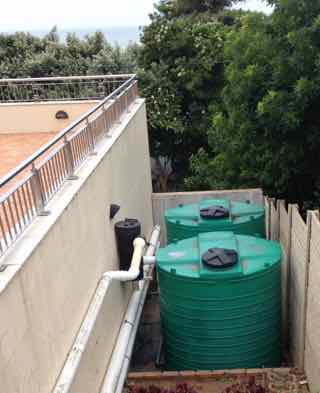
Why install a rainwater harvesting system?
Although various forms of rainwater harvesting have been used for thousands of years, as an organized industry, it is still in its infancy. At present, no national standards are in place regulating its use. The onus is thus on the installer to ensure that the installed system complies with similar regulations. Whatever kind of systems is considered - rainwater harvesting is not just a pipe running off a roof into tank.
